Nassau Food, Rum and Junkanoo: The Culture Side of the Island
Nassau's food is conch, its drink is rum or Sky Juice, and its loudest cultural event happens twice a year on Bay Street before dawn.
The private Jeep’s current itinerary lists stops at Nassau sights including the Queen’s Staircase, the Caves, Graycliff and John Watling’s. Several other places are drive-pasts: do not count Arawak Cay as an included meal stop or Cable Beach as swimming time. Confirm admissions for the option selected.
Booking facts checked September 12, 2026. Dollar amounts and booking counts below are historical planning examples, not current quotes. Use the rechecked booking choices for your date and confirm the exact option and meeting point.
Choose rum and cocktails, a food walk or a Junkanoo culture stop. Start with the experience, then compare the actual date, party total and departure details.
Starting choice: Explore Nassau rum & food walk 3h · Five rum tastings, three cocktails, conch fritters and a hands-on cocktail session, with access to a private speakeasy.
What the culture side of Nassau costs
John Watling's Distillery is free to walk into, daily 10:00 to 18:00. Tour prices are the historical planning examples and move with season and demand.
What is Bahamian food actually like?
Bahamian food is built on conch, on pigeon peas cooked with rice, and on fish that is either fried or stewed in a dark peppery gravy. Lime, onion and sweet pepper do most of the seasoning. It is not chilli-hot in the Jamaican sense, portions are large, and almost every plate arrives with peas and rice and a wedge of johnny cake. The register is closer to American Southern cooking than to the rest of the Caribbean, which surprises a lot of first-time visitors who expected jerk and curry.
Breakfast is where the island cooking is most itself. Stewed fish with grits, or boiled fish with johnny cake, is a working breakfast rather than a tourist dish, and the stalls that serve it are busiest before nine in the morning. Lunch and dinner move towards the fried end: cracked conch, fried snapper, fried plantain on the side. Rum cake shows up as dessert and as the standard souvenir, and one of Nassau's rum-cake bakeries is a scheduled stop on the trolley route.
What you will not find easily near the cruise berths is a cheap plate of it. Passengers consistently report high prices for mediocre food and drink in the streets immediately around the port, which is the single most common food complaint about Nassau. The fix is not complicated: walk further, or take the rum tasting and food walking tour that has already chosen the kitchens. There is a wider list of what else fills a Nassau day in our guide to what there is to do in Nassau.
| Dish | What it is | Where you meet it |
|---|---|---|
| Conch salad | Raw conch diced with onion, sweet pepper and citrus, mixed in front of you | Arawak Cay stalls, Potter's Cay shacks |
| Conch fritters | Chopped conch in fried batter with a dipping sauce | Included on the trolley tour and the rum walking tour |
| Cracked conch | Conch pounded flat, battered and fried, served with peas and rice | Fish Fry restaurants |
| Stewed conch | Conch slow-cooked in a tomato and onion gravy | Potter's Cay and Fish Fry kitchens |
| Stewed fish | Fish in a dark peppery gravy, usually a breakfast plate | Fish Fry and Potter's Cay, early |
| Peas and rice | Pigeon peas cooked into rice, the default side | Under almost everything |
| Johnny cake | Dense, faintly sweet Bahamian bread | Alongside stewed fish and conch |
| Grits | The breakfast partner to stewed or boiled fish | Morning counters at the Fish Fry |
| Fried plantain | Sweet plantain fried soft | Side plate, most Bahamian kitchens |
| Rum cake | Dense cake soaked in rum, also the standard souvenir | Bahamas Rum Cake Factory, a trolley-tour stop |
What is conch and how is it served?
Conch is a large sea snail, and it is the defining Bahamian food. Four preparations cover almost everything you will be offered: conch salad, raw and citrus-cured; conch fritters, chopped and deep fried; cracked conch, pounded and battered; and stewed conch in gravy. Queen conch harvesting is regulated, and the species is CITES-listed. The meat is firm and mild, closer to squid than to clam, and it takes seasoning rather than supplying much of its own.
Conch salad is the one to watch being made. A vendor takes the animal out of the shell, trims it, dices it with onion, tomato and sweet pepper, and dresses it with sour orange and lime juice, sometimes with a scotch bonnet on request. The whole thing happens on the counter in front of you in a couple of minutes, which is also the reason to buy it from a stall with a queue rather than one without.
The regulation matters more than most visitors realize. Bahamian rules require a well-formed flared lip on a harvested queen conch, which is the shell's sign of maturity, and the species sits on the CITES list, so shells and meat can carry export and import paperwork depending on where you are flying home to. If you want a shell as a souvenir, check your own country's rules before you buy one rather than at the airport. Conch turns up in nearly every list of what Nassau is best known for, usually one line above rum and one line below Junkanoo.
What is Sky Juice?
Sky Juice, also called Gully Wash, is gin, coconut water, sweetened condensed milk and grated nutmeg. It is Nassau's own drink, it is served cold in a plastic cup, and it tastes far milder than its alcohol content suggests. The cultural trolley tour includes samples of it, which is the easiest way to try it without guessing at a stall.
The name changes by who is pouring. Purists will tell you Sky Juice and Gully Wash are two slightly different drinks; in practice the ingredients are the same four and the argument is part of the fun. What matters practically is the sweetened condensed milk, which hides the gin completely. Treat the first cup as a full drink rather than a taster.
Beyond that, the drinks list is short and easy to learn. Switcha is the non-alcoholic staple, a Bahamian limeade of key limes or lemons, water and sugar, and it is the thing to order at midday when a rum punch would end your afternoon. Kalik is the local beer. Goombay Smash is the other cocktail everyone has heard of. The legal drinking age is 18, which is worth knowing if you are traveling with older teenagers, and the rum walking tour enforces it with photo ID.
| Drink | What is in it | Where you meet it |
|---|---|---|
| Sky Juice (Gully Wash) | Gin, coconut water, sweetened condensed milk, nutmeg | Sampled on the $55 trolley tour; sold along Arawak Cay |
| Switcha | Key limes or lemons, water, sugar. No alcohol | Every Bahamian kitchen and stall |
| Kalik | The local Bahamian beer | Bars, beach shacks, the Fish Fry |
| Goombay Smash | The other well-known Bahamian cocktail | Beach clubs and downtown bars |
| John Watling's Pale, Amber, Buena Vista | Small-batch rums distilled on the Buena Vista Estate | The distillery at 17 Delancy Street, free entry |
| Rum punch | Rum-based punch, the standard boat-tour drink | One is included on the 3 Islands boat day |
Where do locals eat in Nassau?
Two addresses answer this: Arawak Cay on West Bay Street, known to everyone as The Fish Fry, and Potter's Cay under the Paradise Island bridge. Arawak Cay is the row of Bahamian stalls and restaurants and takes both locals and visitors. Potter's Cay is the working conch and fish stall strip, and it is the less touristed of the two.
The private Jeep’s current itinerary lists stops at Nassau sights including the Queen’s Staircase, the Caves, Graycliff and John Watling’s. Several other places are drive-pasts: do not count Arawak Cay as an included meal stop or Cable Beach as swimming time. Confirm admissions for the option selected. Related reading: The official destination listing for the Fish Fry Pirate Jeep tour trolley
Potter's Cay is different in character. It sits underneath the bridge to Paradise Island, it is built around the mail boats and the fish and conch coming off them, and it is loud, plain and cheap by Nassau standards. The Ministry of Tourism's page on Potter's Cay lists it as a working dock rather than an attraction, which is the right expectation to arrive with. Neither place is dangerous by daylight, and the general picture of which parts of the island to be alert in is set out in our guide to how safe Nassau is.
| Place | What it is | Who is actually there |
|---|---|---|
| Arawak Cay, The Fish Fry | Row of Bahamian stalls and restaurants on West Bay Street | Both. Locals eat here, and it is a Pirate Jeep stop |
| Potter's Cay | Conch shacks and fish stalls under the Paradise Island bridge | Mostly local, built around the mail boats |
| Bay Street and the Straw Market | Shopping strip about 5 minutes from the gangway | Visitors. Passengers report mostly imported souvenirs and heavy sales pressure |
| Junkanoo Beach | Closest public beach to the port, about 15 minutes on foot | Visitors. Bars, music, vendors and paid-chair pressure |
| Graycliff Heritage Village | 1740 colonial estate, now a chocolatier and cigar house | Visitors. On the rum walking tour and the Pirate Jeep route |
| Tasty Teas Bahamas, Delancy Street | Bush-tea and tasting stop | Visitors, via the trolley and Jeep routes |
What is Junkanoo?
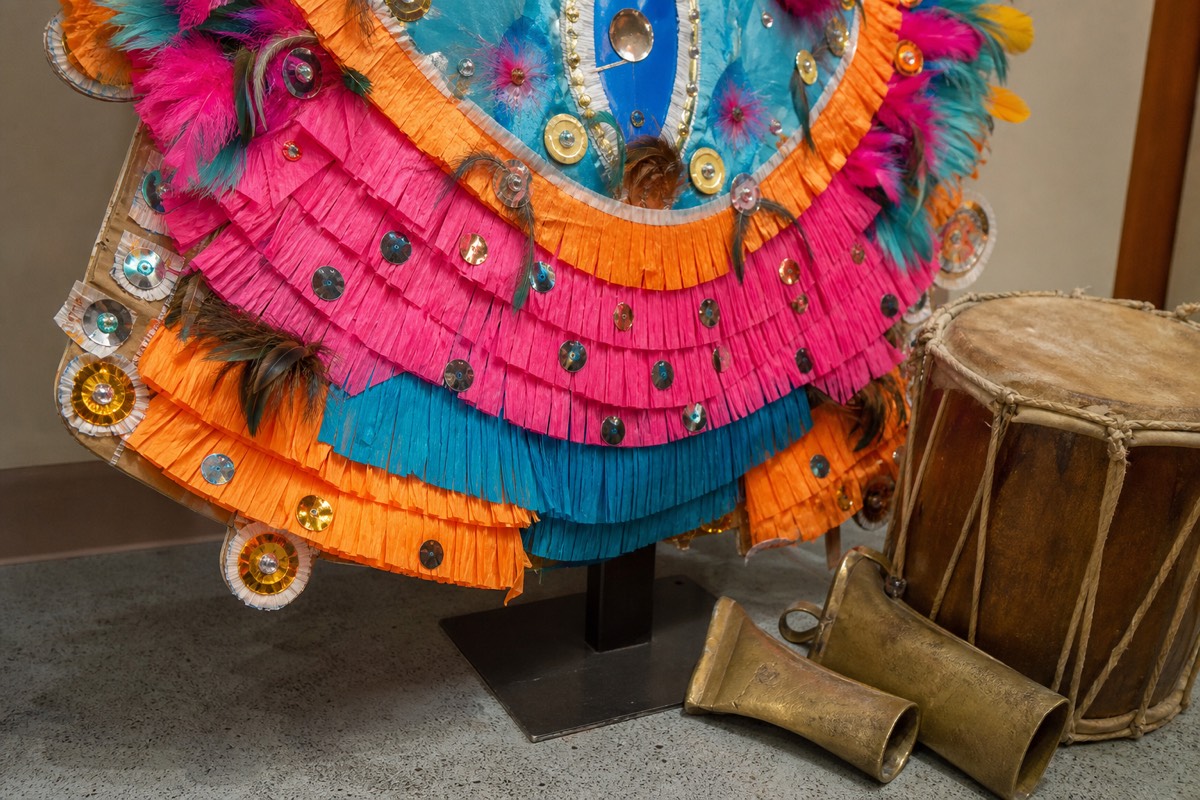
Junkanoo is a Bahamian street parade of goatskin drums, cowbells and brass, danced in costumes built from cardboard and crepe paper. Groups spend months constructing them and then compete for prizes as they come up Bay Street. It is a competition, not a procession, and the noise is the point. Calling it a carnival undersells the scoring, the rehearsal and the rivalry between the big groups.
The costumes are the part that surprises people. They are not fabric. They are built on wire and cardboard frames and covered in thousands of hand-cut crepe-paper strips, some of them large enough that one person wears a structure several meters wide and has to be helped through corners. They are made to last one night. That disposability is deliberate and it is why the craft has stayed a living thing rather than a museum piece.
The music runs on cowbells, whistles, brass and goatskin drums that are heated over a fire before the parade to tighten the skin. The Ministry of Tourism's Junkanoo page gives the official background. If you want the context in daylight and in a quiet room, the Educulture Junkanoo Museum on West Street runs year-round, keeps real costumes on display, and is a short walk from the downtown streets covered on our Nassau history and city tour guide.
When can you see a Junkanoo parade?
The two main parades are on Boxing Day, 26 December, and on New Year's Day, and both start in the small hours of the morning along Bay Street rather than in the afternoon. If you are in Nassau on any other date, there is no street parade to catch, and the Educulture Junkanoo Museum on West Street is the year-round substitute.
The timing catches people out constantly. These are not evening events. The big groups come up Bay Street in the dark, often from around two in the morning, and the crowd is already in place before that. Cruise schedules almost never line up with it, because a ship in port on 26 December is usually alongside from around seven in the morning, by which time the street is being swept. Seeing the real thing generally means staying on the island.
There is a consolation that is better than it sounds. Junkanoo costumes, drums and a rush-out atmosphere are staged at various points through the year for visitors, the redeveloped cruise terminal has its own Junkanoo museum inside the port complex, and Junkanoo Beach carries the name for a reason. Our cruise port guide covers what sits inside the terminal, and if you are ashore without anything booked, our list of what to do in Nassau without an excursion puts the museum in walking order.
| When | What happens | Where |
|---|---|---|
| Boxing Day, 26 December | The main Junkanoo parade, groups competing for prizes, starting in the small hours | Bay Street, downtown Nassau |
| New Year's Day, 1 January | The second major parade, same format, same pre-dawn start | Bay Street, downtown Nassau |
| Any other date | No street parade. Costumes, drums and the history of the groups | Educulture Junkanoo Museum, West Street, weekdays |
| Any cruise day | Junkanoo museum inside the redeveloped terminal complex | Prince George Wharf |
Is there a rum distillery in Nassau?
Yes. John Watling's Distillery sits on the Buena Vista Estate at 17 Delancy Street, a colonial property dating from 1789. Entry is free, it opens daily from 10:00 to 18:00, and it makes small-batch Pale, Amber and Buena Vista rums on site with a tasting room, a shop and a bar. It is a working distillery on a historic estate rather than a bottling plant with a gift counter, and the grounds are part of the visit.
Because entry costs nothing, the distillery has become the default stop on almost every land tour in the city. The ATV route stops there. The Pirate Jeep itinerary includes it. The rum and food walking tour actually begins at the Buena Vista Estate and builds outward from it. You can also simply walk in, which is worth knowing if your day is unbooked, since Delancy Street is an easy walk up from Bay Street. The distillery's own site lists current opening details.
The current ATV listing includes third-party liability insurance and has eliminated its fuel surcharge. Do not add the former $69.95 insurance and $22 fuel charges to a new quote. Damage to the vehicle or driver is not covered; lunch and any private-residence transfer can cost extra. Drivers must be at least 21 with a valid licence. Related editorial: self-drive ATV route through the forts and the distillery
What did Nassau have to do with Prohibition?
Between 1920 and 1933, when alcohol was banned in the United States, Nassau harbor became one of the main rum-running hubs supplying the American east coast. Liquor was landed legally in the Bahamas, warehoused in downtown Nassau, and run north by boat. Bill McCoy, the original "the real McCoy", and Gertrude "Cleo" Lythgoe both worked out of the harbor.
The physical evidence is still on the streets. Several colonial buildings in the downtown grid served as liquor lockups during those years, and the walking tour that starts at the Buena Vista Estate routes deliberately through them. Bill McCoy's reputation came from selling uncut spirit rather than the watered-down product common at the time, which is where the phrase attached to his name. Cleo Lythgoe, known as the Bahama Queen of Whisky, ran her own operation from Nassau in the same period.
The private Jeep’s current itinerary lists stops at Nassau sights including the Queen’s Staircase, the Caves, Graycliff and John Watling’s. Several other places are drive-pasts: do not count Arawak Cay as an included meal stop or Cable Beach as swimming time. Confirm admissions for the option selected. Related reading: private Jeep tour of the forts, caves and colonial estates rum walking tour
| Year | What happened in Nassau |
|---|---|
| 1696 to 1720 | Nassau operates as a pirate base. Blackbeard, Calico Jack and Anne Bonny are among the names |
| 1740 | Graycliff is built, later a hotel, restaurant, chocolatier and cigar house |
| 1789 | The Buena Vista Estate is built, now home to John Watling's Distillery. Fort Charlotte is built the same year |
| 1793 to 1794 | The Queen's Staircase is cut from the limestone ridge, 65 steps today, originally 66 |
| 1920 | US Prohibition begins. Nassau harbor becomes a major rum-running hub |
| 1920s | Bill McCoy, "the real McCoy", and Gertrude "Cleo" Lythgoe operate out of Nassau |
| 1933 | Prohibition is repealed and the run north collapses |
Which tour covers the food and rum properly?
Small-group capacity makes checking dates before travel useful, but there is no verified same-day sellout pattern for these departures. The rum walk is capped at twelve and horseback eligibility needs advance confirmation; check the actual date rather than assume walk-up tickets.
The $55 cultural trolley tour is the cheaper and broader option. 2½ hours on an open electric trolley from the Straw Market side, with Bahamian treats and conch fritters on board, samples of Sky Juice, a ten-minute tasting at the Bahamas Rum Cake Factory, a tasting at Tasty Teas Bahamas, a pass by the Arawak Cay stalls and stops at the Queen's Staircase, the Atlantis grounds and Junkanoo Beach. It is a tasting tour rather than a food tour, and it works with children, which the rum tour does not.
The private Jeep’s current itinerary lists stops at Nassau sights including the Queen’s Staircase, the Caves, Graycliff and John Watling’s. Several other places are drive-pasts: do not count Arawak Cay as an included meal stop or Cable Beach as swimming time. Confirm admissions for the option selected. Related reading: Pirate Jeep tour what Nassau excursions cost
| Tour | Price | Hours | What you eat and drink | Group and rules |
|---|---|---|---|---|
| Rum tasting and food walking tour | $98 | 3 | 5 rum tastings, 3 craft cocktails, mixology tutorial, conch fritters, rum cake, appetizers | Capped at 12 guests, 18+, photo ID, self-transit to the start |
| Cultural trolley tour | $55 | 2 | Bahamian treats, conch fritters, Sky Juice samples, rum cake tasting, bush-tea tasting | Open electric trolley, family friendly, no full meal |
| Pirate Jeep sightseeing tour | $165 | 3 | Bottled water only. Stops at the Fish Fry and Graycliff Chocolatier, food bought separately | Private Jeep or van, all site admissions included |
Can you fit the food and culture side into a cruise day?
Comfortably. A ship is typically alongside for six to eight hours, arriving between 7:00 and 8:00 and leaving between 16:00 and 18:00, and all three of these tours run two to three hours. The one to watch is the rum walking tour, which uses self-transit rather than port pickup, so build in the walk at both ends.
The distances are short. From the gangway it is about five minutes on foot to Bay Street, about thirteen to the Queen's Staircase and about fifteen to Junkanoo Beach, and Delancy Street sits in the same walkable grid. Nothing in this article needs a taxi except the Fish Fry at Arawak Cay and Potter's Cay, and the tours that visit them supply the transport themselves.
Take the morning slot if it is offered. Mornings are cooler and quieter, and on days when four to six ships are in, the crush on Bay Street builds fast: the port has six berths, and the record single day was 33,254 passengers. Booking ahead also matters more than usual here, because the rum tour's 12-place cap fills. If you are weighing this against a boat day instead, the whole range is on our list of tours in Nassau Bahamas.
| Plan | Time needed | Fits a 6 to 8 hour port window? |
|---|---|---|
| Cultural trolley tour | 2 hours | Yes, with hours left over for Bay Street |
| Rum and food walking tour | 3 hours plus the walk each way | Yes on a morning slot. 18+ only |
| Pirate Jeep tour | 3 hours | Yes, transport included both ways |
| Trolley tour then lunch at the Fish Fry on your own | About 4 hours plus a taxi | Yes, agree the taxi fare first |
| Walk to Bay Street, the Straw Market and the Queen's Staircase unguided | About 1 to 2 hours | Yes. About 13 minutes on foot from the gangway |
| Rum walking tour and Pirate Jeep in one day | 6 hours plus transfers | Tight. We would not plan it against a ship departure |
What should you sort out before you go?
Four things: book the rum tour ahead because it takes 12 people, carry photo ID if alcohol is involved because the drinking age is 18 and it is checked, agree a taxi fare before you get in because Nassau taxis are unmetered, and eat the conch salad where the queue is. None of that is complicated, and all four are the things visitors most often get wrong.
On money, the local transport figures are small and useful: a jitney bus is $1.25, a water taxi to Paradise Island runs about $4 to $7, and a taxi to Cable Beach runs about $18 to $24 for one or two passengers. Free cancellation on the listings we carry is typically 24 to 48 hours ahead, which gives you room to move a tasting tour if the day turns.
- The rum tour starts at the Buena Vista Estate, not at the port. Allow the walk.
- The trolley tour leaves from the Straw Market and cruise-port side, which is the easier start if you are on a tight schedule.
- John Watling's is free to walk into, daily 10:00 to 18:00, if you would rather not book anything.
- Prices are current rather than permanent. Check the live listing before you plan around a figure.
One last honest note on expectations. Passengers who pre-book a small-group or private tour consistently report a better day than those who freelance on foot, and the most repeated single piece of advice in cruise forums is to decide what you are doing before the gangway opens and then say a firm no to everything else on the street. That advice applies to the food side more than anywhere, because the pressure is heaviest exactly where the cheapest-looking food is.